What Landfill Tipping Fees Really Cost: Hidden Markups and Regional Differences

When businesses think about their waste disposal costs, most assume the largest expense is simply “paying for trash pickup.” What often goes unnoticed are landfill tipping fees – the charges haulers pay when they dump waste at a landfill. These costs are rarely passed through at face value. Instead, they are often marked up, buried under vague invoice line items, or unevenly applied across regions, creating hidden expenses that businesses may not even realize they’re paying.
For multi-location companies, these costs can quietly drain budgets, especially when compounded by regional differences and vendor practices.
What Are Landfill Tipping Fees?
A tipping fee is the charge per ton of municipal solid waste (MSW) that landfill operators impose to cover operating costs, environmental compliance, and long-term maintenance. While straightforward in theory, the reality is that most businesses never see these fees transparently on their invoices. Instead, they are bundled under categories such as “disposal” or “processing,” and businesses are expected to accept them without question.
Why Businesses Rarely See True Costs
The lack of visibility benefits waste vendors far more than their customers. Many haulers use tipping fees as a cost category where they can add hidden markups. Key ways this happens include:
- Invoice line items are vague or bundled, hiding the true tipping fees
- Vendors add automatic escalators or administrative fees without explanation
- Flat rates often exceed actual disposal costs, creating hidden profit for the hauler
For example, if a landfill in your region charges $70 per ton, your invoice may reflect $80 or $90 per ton with little or no explanation. These “pass-through” charges are often buried in the fine print of contracts, making it difficult for businesses to verify what they are actually paying. To make matters worse, the national haulers own most of the landfills they use further lining their own pockets.
Regional Differences: Why Location Matters
Geography plays a major role in waste disposal pricing. Tipping fees vary widely across the United States due to differences in landfill capacity, state and local regulations, and population density. Businesses operating in multiple regions can face significantly different costs for identical waste volumes. According to Waste Business Journal in their April 2024 report, average tipping fees by region:
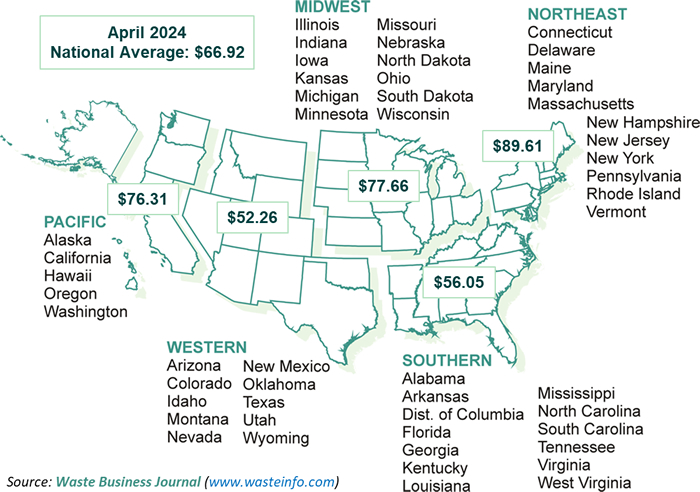
In the Northeast, landfill space is scarce and regulatory oversight is strict, which drives prices higher. Meanwhile, the Midwest benefits from larger landfill capacity and lower demand, resulting in lower tipping fees. For businesses generating thousands of tons of waste per year, these regional disparities alone can translate to tens of thousands of dollars in extra costs – before vendor markups are even considered.
Case Study: Northeast vs. Midwest Costs
Consider a company producing 1,000 tons of waste annually. Disposal in the Northeast would cost roughly $89,610 in base tipping fees, while the same volume in the Midwest would cost $77,660 – a difference of nearly $12,000 per year. Layer on hidden markups, administrative add-ons, and automatic contract escalators, and the actual gap in spend could be even larger.
The Cost of Lack of Transparency
Without clear visibility into tipping fees, businesses cannot benchmark their waste disposal costs against industry norms. This opacity can lead to:
- Overpaying for disposal without realizing it
- Difficulty comparing vendors or negotiating better contracts
- Compounding costs over multiple years, turning small per-ton markups into tens of thousands of dollars in unnecessary spending
Over time, these hidden fees can drain budgets and reduce funds available for other business initiatives.
How Businesses Can Take Control
The good news is that businesses are not powerless. To regain control of waste spend, companies can:
- Demand line-item invoice transparency from vendors
- Benchmark tipping fees against regional averages to spot discrepancies
- Negotiate clear, verifiable disposal cost pass-throughs in contracts
- Consider third-party experts for invoice audits and cost recovery
Partnering with experts ensures that businesses only pay fair, verifiable charges, and provides visibility into where every dollar of waste-spend goes.
Conclusion
Landfill tipping fees may not seem like the most pressing business expense, but their impact is far greater than many realize. Vendors routinely use them to inflate invoices, and regional differences only amplify the problem for companies with multiple locations.
By understanding how these fees work, insisting on transparency, and leveraging expert partners to audit and manage contracts, businesses can protect themselves from unnecessary charges. What you don’t see on your invoice can hurt you – but with the right oversight, tipping fee markups don’t have to drain your bottom line.
National Waste Associates
At National Waste Associates (NWA), we don’t just pass-through landfill tipping fees and other ancillary fees. We review every single invoice, every single month to ensure any fee that gets tacked onto an invoice is verifiable. When it comes to landfill tipping fees, haulers who are adding increases must provide a letter from the landfill indicating the increase. For example, if a hauler is increasing their rates by 5%, they need to provide proof from the landfill that they are being charged an added 5%. Any other percent is not accepted.
The bottom line: NWA always looks after our customer’s bottom line!
Learn more about our waste & recycling services by
calling 888-692-5005 x6 or sending us an
email at sales@nationalwaste.com
 BIC License #1496