
Contract Renewal Traps: Automatic Fee Increases You Missed in Small Print

For many businesses, waste management contracts fall into the “set it and forget it” category. Once a service agreement is signed, it’s common for facility managers to assume the costs will remain stable unless service levels change. Unfortunately, this is exactly the assumption that haulers exploit.
Hidden within the fine print of many waste vendor contracts are renewal traps and automatic escalation clauses that can drive up costs year after year – without you even realizing it. These fee increases may be legal, but they’re rarely transparent, and they can wreak havoc on budgets over time.
How Renewal Clauses Work in Waste Vendor Contracts
Most waste management contracts include renewal provisions that automatically extend the agreement unless the customer provides written notice of cancellation within a narrow window – sometimes as little as 30 days before expiration. If that deadline is missed, the contract renews, often at higher rates or under unfavorable terms.
These “evergreen” clauses are designed to lock businesses in, making it difficult to renegotiate or switch vendors when costs climb.
The Fine Print on Automatic Fee Increases
Beyond renewals, many contracts contain clauses that allow vendors to raise rates annually, sometimes tied to vague references like “increases in operating costs,” “market conditions,” or “fuel surcharges.” These terms give haulers wide discretion to increase prices without clearly justifying them.
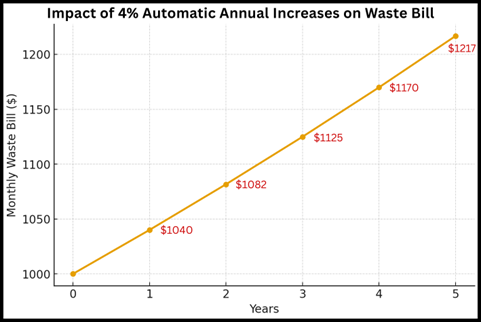
Some contracts even layer increases: a 4% annual escalation clause on top of “cost pass-through” adjustments, compounding the financial impact. Over a five-year contract, these increases can inflate waste costs by 20–40% without any additional benefit to the customer.
Common Traps Hidden in the Small Print
Here are the most frequent “gotchas” buried in waste vendor contracts:
- Auto-Renewal Provisions – Contract rolls over for another term unless canceled in a small notice window. (Generally 30-90 days)
- Escalation Clauses – Annual increases based on inflation indexes, market rates, or vague “operational costs.”
- Fuel & Environmental Surcharges – Fees that rise independently of service levels.
- Termination Penalties – Heavy fines or full payout requirements if you attempt to exit early.
- One-Sided Flexibility – Vendor can adjust rates, but customer cannot adjust service without penalty.
The Financial Impact on Businesses
These traps aren’t just an inconvenience – they’re a significant budget drain. Consider a business that signs a three-year contract at $5,000/month:
- With a 4% escalation clause, that rate grows to $5,624/month by year three.
- If the contract auto-renews without notice, the cycle repeats, adding another 12% over the next three years.
- Over six years, the business ends up paying more than $80,000 in hidden increases.
Multiply that across multiple locations, and the numbers quickly escalate into six or seven figures of unnecessary spend.
Red Flags to Watch for in Your Contract
Businesses can protect themselves by carefully reviewing contract language. Warning signs include:
- Vague language like “subject to market conditions” or “vendor discretion.”
- Annual percentage increases without a defined cap.
- Renewal windows buried deep in the contract, usually only 30–90 days.
- Multi-year renewal terms instead of month-to-month extensions.
- Excessive termination penalties compared to industry norms.
How to Avoid Getting Caught in Renewal Traps
Here are proactive steps businesses can take:
- Calendar Renewal Dates – Track expiration deadlines and set alerts 90–120 days ahead.
- Negotiate Out Escalation Clauses – Request caps on annual increases (e.g., no more than 2–3%).
- Demand Transparency – Require vendors to provide documentation for surcharges.
- Seek Flexible Terms – Push for shorter contracts or month-to-month extensions after the initial term.
- Conduct Contract Audits – Have waste experts review contracts for hidden traps before signing.
How NWA Protects Clients from Contract Renewal Traps
At National Waste Associates, we’ve reviewed thousands of vendor contracts and know exactly where to find hidden renewal clauses and escalation language. Our team negotiates on behalf of clients to:
- Remove or limit auto-renewal provisions.
- Cap annual increases within fair market limits.
- Eliminate excessive termination penalties.
- Ensure all surcharge language is transparent and verifiable.
By proactively managing vendor contracts on behalf of our clients, NWA prevents surprise renewals and compounding costs – delivering measurable, sustainable savings.
Conclusion
Waste haulers rely on contract traps to boost their profits – betting that businesses won’t notice the fine print. By identifying auto-renewal clauses, controlling escalation terms, and partnering with experts like NWA, companies can stop the cycle of hidden increases and regain control of their budgets.
When it comes to waste management, what you don’t know in the contract can cost you dearly. But with the right oversight, you can turn those hidden traps into opportunities for savings and transparency.
Learn more about our waste & recycling services by
calling 888-692-5005 x6 or sending us an
email at sales@nationalwaste.com
 BIC License #1496