
Eliminating Material Inefficiencies in Manufacturing
Table of Contents
Quick Hits: What You Need to Know
- Manufacturing waste can occur throughout the production process, not just at the waste dock.
- Some process waste is unavoidable, while other material losses can be prevented.
- Damaged materials, excess inventory, packaging, and production defects are common sources of avoidable waste.
- Reusing materials and optimizing packaging can reduce both material consumption and disposal costs.
- Measuring waste against production output can reveal inefficiencies that total waste volumes alone may hide.
- Preventing material waste can improve operational efficiency while reducing disposal, purchasing, and handling expenses.
When manufacturers think about waste, the first image that often comes to mind is a dumpster filled with scrap, packaging, or discarded materials. But by the time a material reaches the waste dock, the opportunity to save money may have already passed.
Excess packaging, damaged raw materials, production offcuts, rejected products, obsolete inventory, and inefficient processes can all consume valuable resources long before anything is thrown away. For manufacturers, reducing waste therefore starts well before disposal – it starts on the production floor.
Waste Starts on the Production Floor
A manufacturer can have a well-managed recycling program and still generate significant amounts of unnecessary waste.
Consider a production line that regularly cuts material into specific dimensions. The resulting offcuts may be unavoidable to some degree, but what if the cutting pattern could be redesigned to produce fewer remnants? Or if those remnants could be used elsewhere in the facility?
The same principle applies to packaging. A manufacturer may recycle cardboard and plastic successfully, but if products are consistently being shipped with more packaging material than necessary, recycling only addresses the final step of the problem.
This is why waste minimization in manufacturing requires looking upstream. Instead of asking only, “How do we dispose of this material?” manufacturers should also ask:
Why did we use this material in the first place, and could we have used less, reused it, or prevented it from becoming waste?
That shift can uncover opportunities that traditional waste audits may overlook.
The Difference Between Process Waste and Preventable Waste
Not all manufacturing waste can – or should – be eliminated.
Some scrap material is an inherent part of the production process. Cutting, machining, trimming, molding, and other processes can naturally create residual materials. Attempting to eliminate every ounce of scrap may be impractical or even counterproductive.
The more useful question is whether the amount of waste being generated is reasonable for the process.
For example, a manufacturer might establish a baseline for the amount of scrap material typically generated when producing a particular component. If scrap levels suddenly increase, that could indicate equipment problems, incorrect settings, poor-quality inputs, or production defects.
This creates an important distinction:
- Process waste is material that is reasonably expected from a production method.
- Preventable waste is material lost because of inefficiency, errors, damage, overproduction, poor planning, or unnecessary consumption.
The goal isn’t necessarily zero waste. It’s identifying where waste exceeds what the process actually requires.
Where Manufacturing Materials Commonly Get Lost
Material inefficiencies can occur at virtually every stage of a manufacturing operation.
During purchasing and inventory management, materials may become obsolete before they are used. Overstocking can also increase the likelihood of damage, deterioration, or expiration, particularly for materials with limited shelf lives.
During storage and handling, products and raw materials can be damaged by improper stacking, transportation, or environmental conditions. A material that could have entered production instead becomes scrap.
During production, defects and inaccurate processes can turn valuable inputs into unusable products. Even small amounts of excess material per unit can become significant when multiplied across thousands or millions of units.
Then there is packaging, where oversized boxes, excessive protective materials, single-use components, and inefficient packaging designs can create unnecessary material consumption.
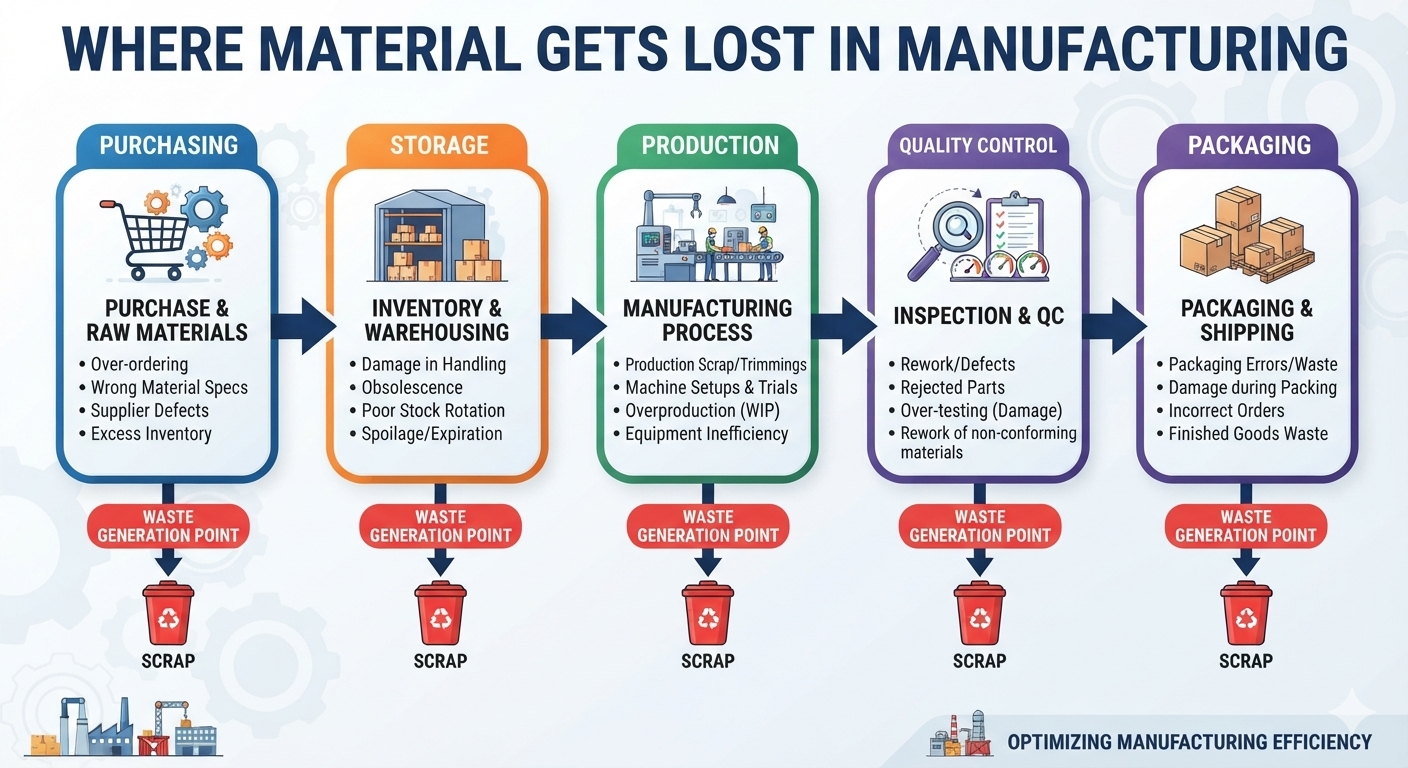
Looking at these stages collectively can reveal a bigger picture: waste is often the result of several small inefficiencies rather than one major problem.
Reducing Packaging and Material Overuse
Packaging is one of the easiest places for manufacturers to identify opportunities for waste reduction.
Using a larger box than necessary, adding unnecessary layers of protective material, or relying on single-use packaging when reusable alternatives are practical can increase both purchasing and disposal costs.
Manufacturers can review packaging by asking:
- Is the packaging appropriately sized for the product?
- Can packaging materials be reduced without compromising product protection?
- Can reusable containers or pallets replace disposable alternatives?
- Can packaging be standardized across similar products?
- Can suppliers reduce the packaging used to deliver incoming materials?
The goal isn’t simply to eliminate packaging. Damaged products can create significantly more waste than the packaging used to protect them. Instead, manufacturers should look for the point where material efficiency, product protection, and cost are appropriately balanced.
Supplier collaboration can also make a difference. If a company receives large quantities of components in excessive packaging, discussing alternative packaging arrangements with suppliers may reduce waste before materials even enter the production process.
Reusing Production Materials Where Possible
One of the most effective ways to minimize manufacturing waste is to keep materials in use for as long as possible.
Production offcuts, excess materials, pallets, containers, packaging components, and other materials may have applications elsewhere in the facility – or even in another production process.
For example, certain scrap materials may be suitable for another product or process rather than being immediately discarded. Reusable shipping containers can potentially replace disposable packaging. Pallets and other durable transport materials may be repaired and reused rather than continuously replaced.
Manufacturers can also examine whether materials currently classified as waste have a resale, recycling, donation, or secondary-use opportunity.
This is where waste management and production teams can benefit from working together. A material that appears to be “trash” to one department may represent a useful resource to another.
A waste audit can help identify these opportunities by examining not just how much material is discarded, but what types of materials are being discarded and why.
Measuring Waste Per Unit of Production
Simply tracking the total amount of waste a manufacturing facility generates can provide useful information, but it doesn’t tell the whole story.
Imagine that a facility generates 100 tons of waste one month and 120 tons the next. At first glance, the increase looks concerning. But if production also increased by 30%, the facility may actually be generating less waste relative to its output.
This is why manufacturers should consider measuring waste per unit of production.
Depending on the operation, this could mean tracking waste by:
- Pounds or tons per finished product
- Waste per production run
- Scrap percentage
- Material yield
- Defective units
- Packaging material per shipment
- Recycled material as a percentage of total waste
For example, if a facility produces 100,000 units and generates 50 tons of waste, it has a different efficiency profile than a facility generating 50 tons of waste while producing only 50,000 units.
Tracking these metrics over time can help manufacturers identify trends, establish realistic benchmarks, and determine whether process improvements are actually reducing material losses.
It can also help separate temporary fluctuations from recurring inefficiencies. A one-time increase in scrap may have a straightforward explanation. A gradual increase in waste per unit could point to a deeper operational issue.
Turning Waste Reduction into an Operational Strategy
Eliminating material inefficiencies isn’t simply an environmental initiative. It can be a practical manufacturing cost reduction strategy.
Every unnecessary pound of material represents more than a potential disposal expense – it may also represent the cost of purchasing, transporting, storing, handling, processing, and ultimately disposing of that material.
Reducing that material loss can therefore create savings at multiple points in the operation.
Manufacturers should start by identifying where the largest material losses occur, determining which losses are unavoidable, and investigating which ones can be prevented. From there, production teams, procurement departments, quality teams, and waste management partners can work together to establish measurable improvement goals.
A more efficient manufacturing operation doesn’t necessarily produce zero waste. It produces less unnecessary waste and gets more value from every material it purchases.
Conclusion
The most effective waste management strategy often begins before waste exists. By identifying material inefficiencies throughout purchasing, storage, production, packaging, and disposal, manufacturers can reduce unnecessary material consumption while improving operational efficiency and controlling costs.
National Waste Associates can complement these efforts by helping manufacturers analyze waste streams, optimize collection and disposal programs, identify diversion opportunities, and manage waste services across multiple facilities.
If your manufacturing operation is generating more waste than expected, the problem may not be limited to your waste services. A closer look at where materials are being lost can uncover opportunities to reduce waste and the costs associated with it.
Learn more about our waste & recycling services by
calling 888-692-5005 x6 or sending us an
email at sales@nationalwaste.com
Frequently Asked Questions (FAQ)
Material inefficiency occurs when a manufacturing process uses or loses more raw materials, packaging, or other resources than necessary to produce the desired output. Examples include excessive scrap, product defects, damaged inventory, overpackaging, and unnecessary material consumption.
Process waste is material that is reasonably expected as part of a manufacturing process, such as certain cutting or machining scrap. Preventable waste results from issues such as defects, poor planning, excess inventory, damage, overproduction, or inefficient material use.
Manufacturers can reduce material waste by improving production processes, minimizing defects, optimizing inventory, reducing unnecessary packaging, reusing materials, improving supplier practices, and measuring waste relative to production output.
Waste per unit of production provides more useful context than total waste volume alone. It allows manufacturers to determine whether waste is actually becoming more or less efficient as production levels change.
In many cases, yes. Depending on the material and manufacturing process, scrap may be reused internally, incorporated into another process, returned to a supplier, sold for recovery, or sent to an appropriate recycling stream. A waste audit can help identify these opportunities.
National Waste Associates can help manufacturers evaluate waste streams, manage waste and recycling vendors, identify diversion opportunities, optimize equipment and pickup schedules, audit invoices, and provide data that helps businesses better understand and control their waste programs.
 BIC License #1496
