Why Professional Service Companies Need Better Waste Visibility

Table of Contents
Professional service companies excel at managing client relationships, project timelines, and operational performance. Yet one area often receives far less attention than it deserves: waste and recycling operations. Because waste management typically represents a relatively small percentage of an organization’s overall budget, it’s easy for inefficiencies to go unnoticed – especially when services are spread across dozens or even hundreds of locations.
For organizations operating multiple offices, branches, or client sites, waste costs can quickly become fragmented across different vendors, contracts, invoices, and local regulations. Without centralized oversight, businesses often miss opportunities to reduce costs, improve sustainability performance, and create more consistent operations. Better visibility into waste data transforms waste management from a routine operational expense into a strategic business function.
Quick Hits: What You Need to Know
- Multi-location businesses often work with numerous waste vendors, making it difficult to identify inconsistencies and unnecessary costs.
- Centralized reporting helps organizations compare locations and quickly identify opportunities for service optimization.
- Regular invoice auditing can uncover billing errors, hidden fees, and unauthorized price increases before they become long-term problems.
- Data-driven waste management supports ESG reporting by providing accurate diversion, recycling, and landfill metrics across all locations.
- Standardizing waste programs improves consistency while allowing flexibility for unique site requirements.
- Better waste visibility enables companies to make proactive decisions instead of reacting to problems after costs have already increased.
Why Waste Visibility Is Often Overlooked
Unlike payroll, utilities, or inventory, waste management rarely receives ongoing executive attention. Once dumpsters are installed and collections are scheduled, many organizations assume the program is functioning properly.
In reality, waste programs constantly evolve.
Business volumes fluctuate. Office occupancy changes. New locations open while others close. Municipal recycling regulations change. Vendors adjust pricing. Without routine oversight, waste services that were appropriate two years ago may no longer reflect today’s operational needs.
Professional service companies often prioritize delivering excellent customer service – which they should – but waste operations become decentralized responsibilities handled by individual office managers or facility personnel. Over time this creates inconsistent service levels, varying contracts, and limited visibility into overall company performance.
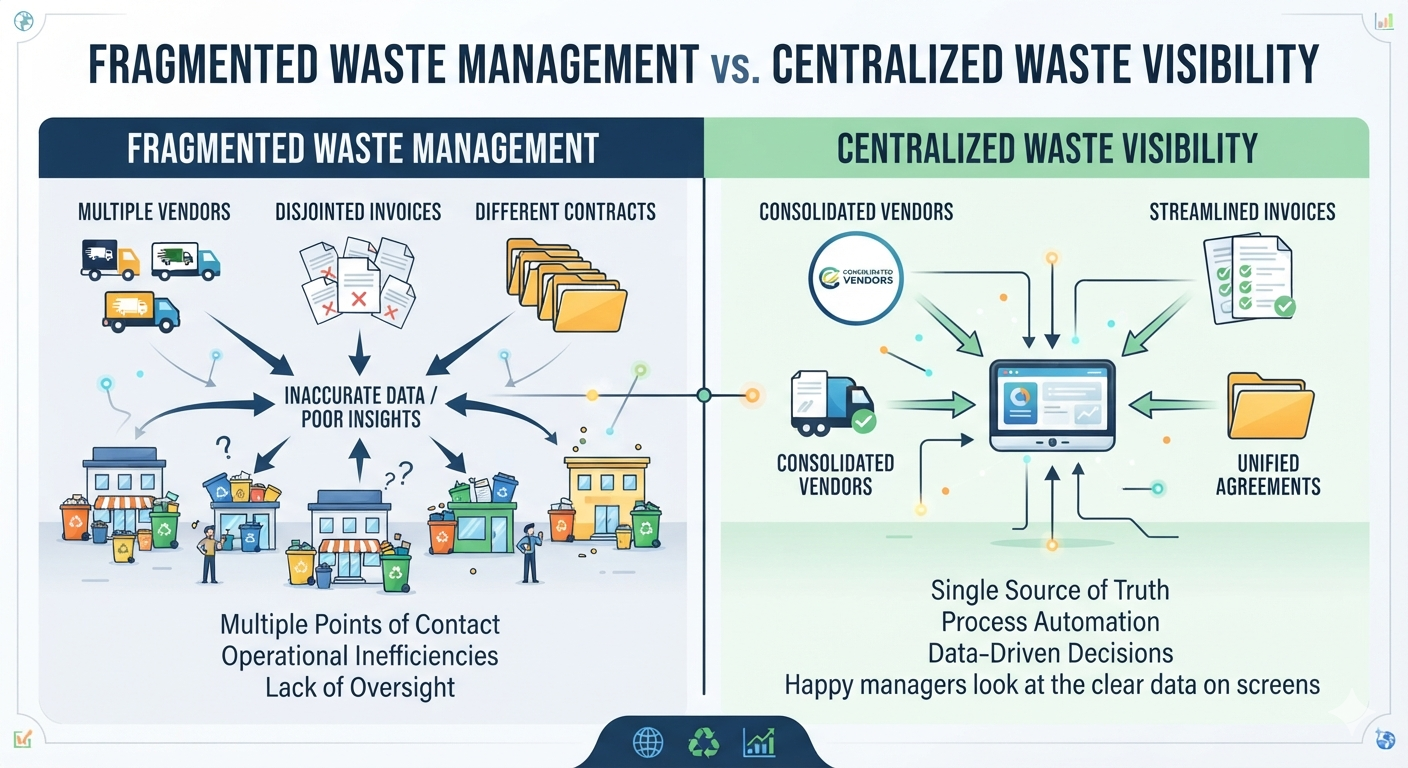
Instead of one coordinated program, organizations frequently end up with dozens of independent waste programs operating simultaneously.
The Challenges of Managing Multiple Waste Vendors
As organizations expand geographically, they often inherit regional waste providers, legacy contracts, and different service standards at each location.
While each vendor may perform adequately on its own, collectively they create operational complexity.
One location may receive weekly invoice reviews while another simply pays bills automatically. One vendor may include recycling reporting while another provides none. Contract terms, surcharge structures, equipment types, and pickup schedules may vary significantly across locations.
The result is a program that’s difficult to evaluate objectively.
Without centralized oversight, businesses may struggle to answer questions like:
- Which locations have the highest waste costs per employee?
- Which vendors consistently deliver the best service?
- Where are recycling rates improving – or declining?
- Which sites experience the most service interruptions?
- Are pricing increases occurring consistently across the portfolio?
These questions become increasingly important as organizations grow.
Understanding Costs Across Different Locations
Waste expenses involve much more than monthly collection charges.
A comprehensive view should include equipment rental, hauling fees, disposal costs, recycling services, fuel surcharges, environmental fees, contamination charges, overage fees, and occasional emergency pickups.
When these costs are spread across multiple accounting systems and invoices, identifying trends becomes extremely difficult.
Organizations that monitor waste data across their entire portfolio can benchmark locations against one another and identify unusual spending patterns much earlier.
For example, one office may generate significantly higher waste costs than similar-sized locations. Another may be paying for oversized containers that are rarely full. A third location may experience repeated contamination fees due to inadequate recycling education.
These differences often remain hidden until businesses begin comparing data across locations.
Using Data to Identify Waste Inefficiencies
Data transforms waste management from guesswork into informed decision-making.
Instead of relying solely on anecdotal feedback, organizations can use reporting to identify measurable opportunities for improvement.
Examples include:
- Rightsizing containers based on actual waste generation.
- Adjusting pickup frequencies to better match seasonal demand.
- Identifying locations with recurring contamination issues.
- Monitoring invoice accuracy across all vendors.
- Tracking diversion rates over time.
- Measuring hauling frequency versus container utilization.
Even relatively small improvements across multiple locations can produce meaningful savings over time.
Organizations also gain the ability to forecast future needs more accurately. Rather than waiting for overflowing dumpsters or emergency service requests, businesses can proactively adjust service levels based on historical trends and operational growth.
This proactive approach minimizes disruption while helping control operating costs.
Improving Sustainability Reporting
Environmental reporting has become increasingly important for many professional service organizations.
Whether driven by investor expectations, customer requirements, internal ESG initiatives, or corporate sustainability goals, companies are being asked to provide more detailed information about their environmental performance.
Waste reporting plays an important role in these efforts.
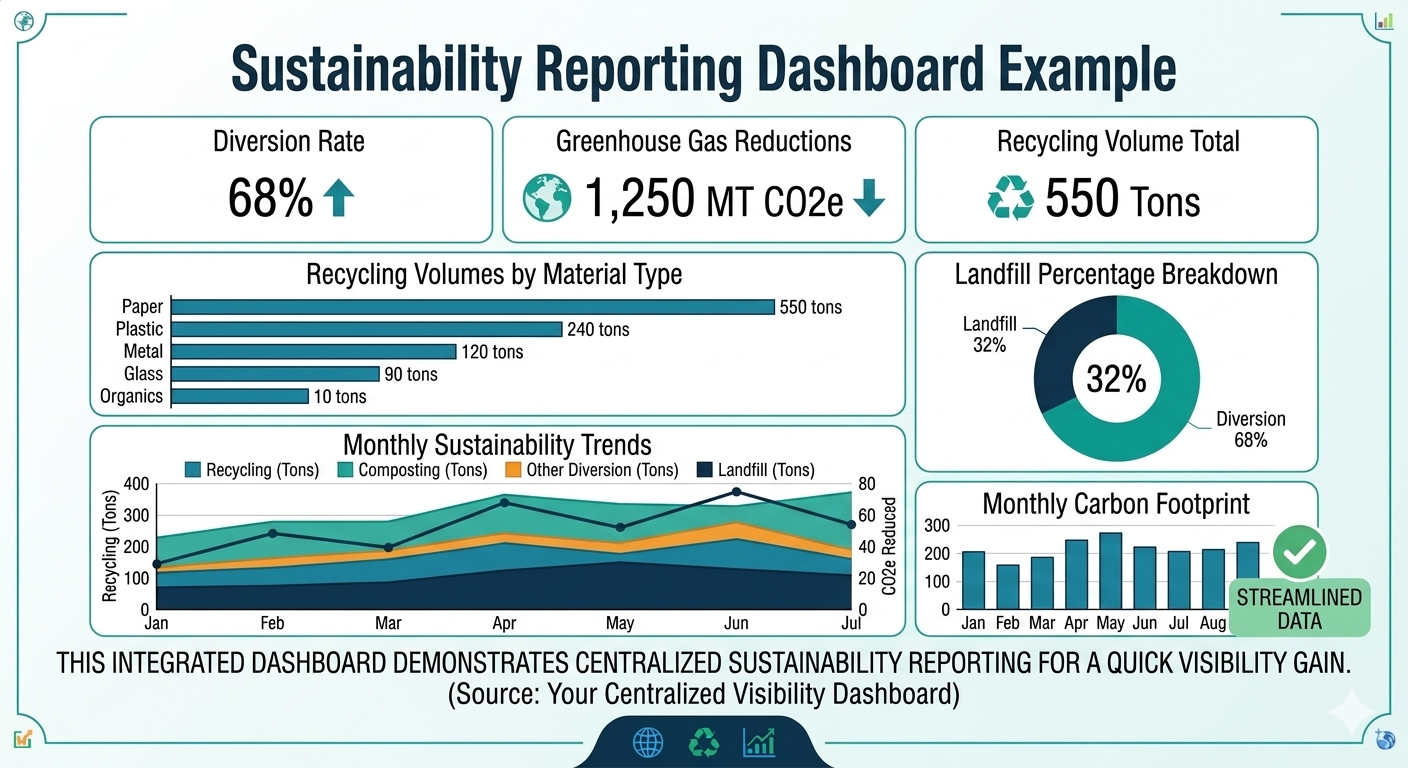
Accurate data allows organizations to monitor:
- Recycling and landfill diversion rates.
- Total waste generation by location.
- Material-specific recycling volumes.
- Greenhouse gas reductions from diversion initiatives.
- Progress toward internal sustainability goals.
Without centralized reporting, gathering this information often becomes a time-consuming manual exercise involving multiple vendors and inconsistent reporting formats.
A standardized waste reporting program provides leadership with reliable information for annual sustainability reports while helping identify additional opportunities for improvement.
Creating a More Strategic Waste Program
The organizations that manage waste most effectively don’t simply react to service issues – they continuously evaluate performance and look for opportunities to improve.
A strategic waste program focuses on ongoing optimization rather than one-time cost reductions.
This includes regularly reviewing service levels, auditing invoices, evaluating vendor performance, monitoring recycling outcomes, and adjusting programs as business operations evolve.
It also means standardizing processes wherever practical while maintaining enough flexibility to accommodate the unique needs of individual locations.
By combining centralized oversight with location-specific knowledge, professional service organizations can improve operational consistency without sacrificing responsiveness.
Over time, this creates a waste program that supports financial objectives, sustainability initiatives, regulatory compliance, and overall operational efficiency.
Conclusion
Greater visibility leads to better decisions. When professional service companies centralize waste reporting and monitor performance across all locations, they gain the insight needed to reduce costs, improve operational consistency, strengthen sustainability initiatives, and eliminate inefficiencies that often go unnoticed.
National Waste Associates helps organizations achieve this visibility through centralized reporting, invoice auditing, vendor management, and data-driven waste optimization. By turning fragmented waste information into actionable insights, NWA enables businesses to build smarter, more efficient waste programs that support long-term operational goals.
Not sure how much visibility you really have into your waste program? A comprehensive review of your current vendors, invoices, and service levels may reveal opportunities to improve efficiency, reduce costs, and strengthen sustainability reporting across your organization.
Learn more about our waste & recycling services by
calling 888-692-5005 x6 or sending us an
email at sales@nationalwaste.com
Frequently Asked Questions (FAQ)
Waste management is often decentralized, with individual locations managing their own vendors, invoices, and service schedules. Without centralized oversight, it becomes difficult to compare costs, monitor performance, or identify opportunities for improvement across the organization.
Useful reporting includes waste generation, recycling rates, landfill diversion, service frequency, invoice accuracy, vendor performance, contamination incidents, equipment utilization, and total costs by location.
Accurate reporting helps identify oversized containers, unnecessary pickups, recurring fees, billing errors, and inconsistent service levels. Addressing these issues can significantly reduce operating expenses over time.
Reliable waste data allows organizations to measure recycling performance, diversion rates, greenhouse gas reductions, and other environmental metrics that support ESG reporting and corporate sustainability goals.
Managing multiple vendors independently often results in inconsistent pricing, service quality, and reporting. Centralized oversight improves standardization, strengthens vendor accountability, and provides leadership with a complete picture of waste operations across the business.
National Waste Associates consolidates waste reporting across locations, audits invoices for billing accuracy, manages vendor relationships, tracks operational performance, and provides actionable insights that help businesses optimize services, reduce costs, and improve sustainability outcomes.
 BIC License #1496